No two pitches are alike
Every pitch is the same size, 22 yards by 10 ft. How it plays depends on four things: the soil underneath, how much grass is left on top, how much moisture is in it, and how hard it has been rolled. Weather and wear then change it during the match.
Under Law 6 of the Laws of Cricket, the ground authority chooses and prepares the pitch before the match. In the IPL that is the host association’s curator and ground staff.
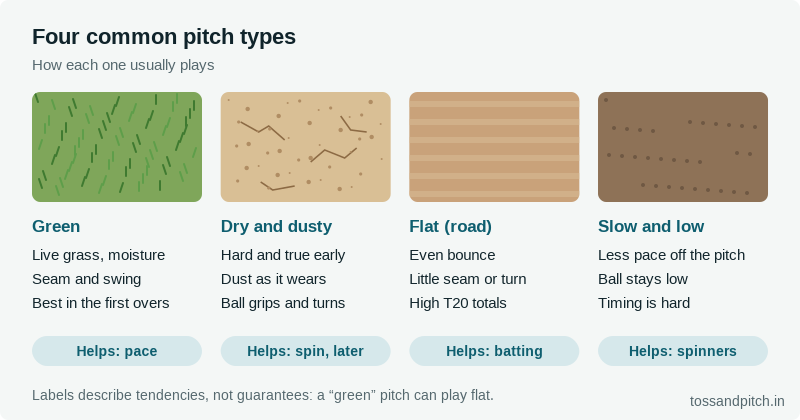
The labels below are shorthand used by commentators and pitch reports. They describe tendencies, not guarantees. A pitch called “green” can play flat, and a “turner” can produce 200.
Batting-friendly and bowling-friendly
A batting-friendly pitch lets the ball come onto the bat at an even height and pace. Batters can trust the bounce and hit through the line, so totals are high.
A bowling-friendly pitch gives bowlers something extra. That might be seam movement off grass, uneven bounce from cracks, grip and turn for spinners, or a slow surface that makes timing hard.
Most IPL pitches sit somewhere in between. On this site each venue’s pitch page uses a 1–10 scale built mainly from recent first-innings scores, adjusted where the chasing record or a small sample calls for it, so “batting” or “bowling” there reflects what has actually happened, not a label.
Green pitch
A green pitch, sometimes called a green top, keeps more live grass and moisture. The ball tends to seam off the surface and can swing in the air, so fast bowlers usually do well, especially in the first few overs.
Green pitches are less common for IPL night matches, but some grass is often left to bind the surface. If the sun dries the grass during a day game, the help for seamers can fade quickly.
Dry and dusty pitch
A dry pitch has had less water and often less grass. Early on it can be good for batting, because it is hard and true. As it wears, the top layer can loosen and turn to dust.
On a dusty surface the ball grips, so spinners get more turn and the ball may stop on the batter. A dry, abrasive surface also roughs up the ball faster, which can help reverse swing later in an innings.
For T20 cricket the useful question is when the wear starts. On some dry pitches the second innings is noticeably slower than the first.
Flat pitch
A flat pitch, also called a road or a belter, has even bounce, little seam movement and little turn. It is the classic high-scoring T20 surface.
Bowlers rely on change of pace, cutters and yorkers rather than help from the surface. Short boundaries and a fast outfield add to the effect.
Slow and low pitch
On a slow, low pitch the ball comes off the surface with less pace and stays lower than the batter expects. Timing is hard, and big hitting is risky.
These surfaces tend to suit spinners and medium-pacers who take pace off the ball. Totals that look modest on paper can turn out to be competitive.
Red soil vs black soil pitches in India
Indian pitches are often described by the soil used in them. Sources agree on the broad differences.
| Red soil | Black soil | |
|---|---|---|
| Clay content | Lower, more sand and silt | Higher |
| Moisture | Absorbs less, dries fast | Holds moisture longer |
| Bounce and pace | Usually more | Usually less, lower bounce |
| Spin | Turn and bounce as it dries and cracks | Turn grows as it wears, often slower |
| Wear | Can crumble sooner | Tends to last longer |
Red soil. With less clay, a red-soil pitch dries quickly and tends to give more bounce and carry. Fast bowlers often like it early. Batters who trust the bounce can play their shots. As the surface dries and cracks, spinners can get both turn and bounce. Wankhede Stadium in Mumbai is widely described as a red-soil ground, and for the India v Bangladesh Test in September 2024 Chennai used a strip made with red soil from Mumbai.
Black soil. With more clay, a black-soil pitch holds moisture and usually plays lower and slower. It tends to turn more as the match goes on, which suits spinners. Batters often need time to settle, and wickets can fall in clusters.
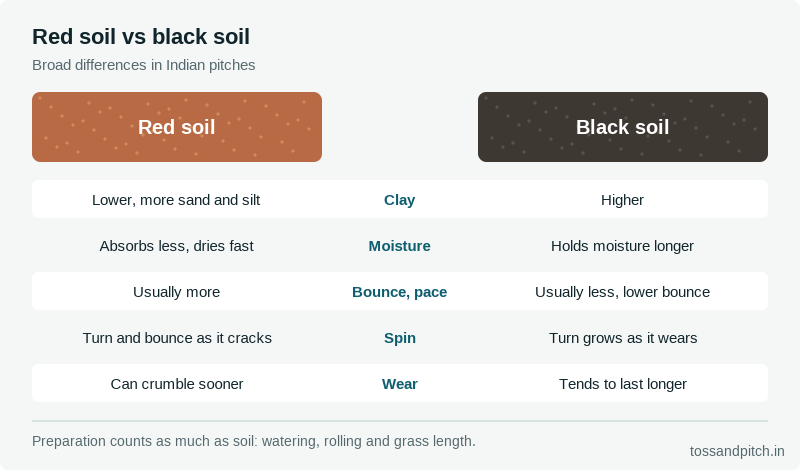
Two cautions matter. First, a ground can prepare strips with different soils, as Chennai has done by laying some red-soil pitches alongside its usual black-soil ones, so the venue alone does not always tell you which soil a given match will use. Second, preparation counts as much as soil: watering, rolling and grass length can make a black-soil pitch play fast or a red-soil pitch play slow.
How to use these labels
Treat the pitch type as a starting point, then check three things before a match.
- How much grass is left, and how much moisture the curator has kept in.
- Whether the strip is fresh or has been used earlier in the season.
- Match-night weather, especially dew, which can matter more than the soil in an evening T20.
A pitch report pulls these together. Recent scores at the venue tell you how the same square has actually played.