The short answer
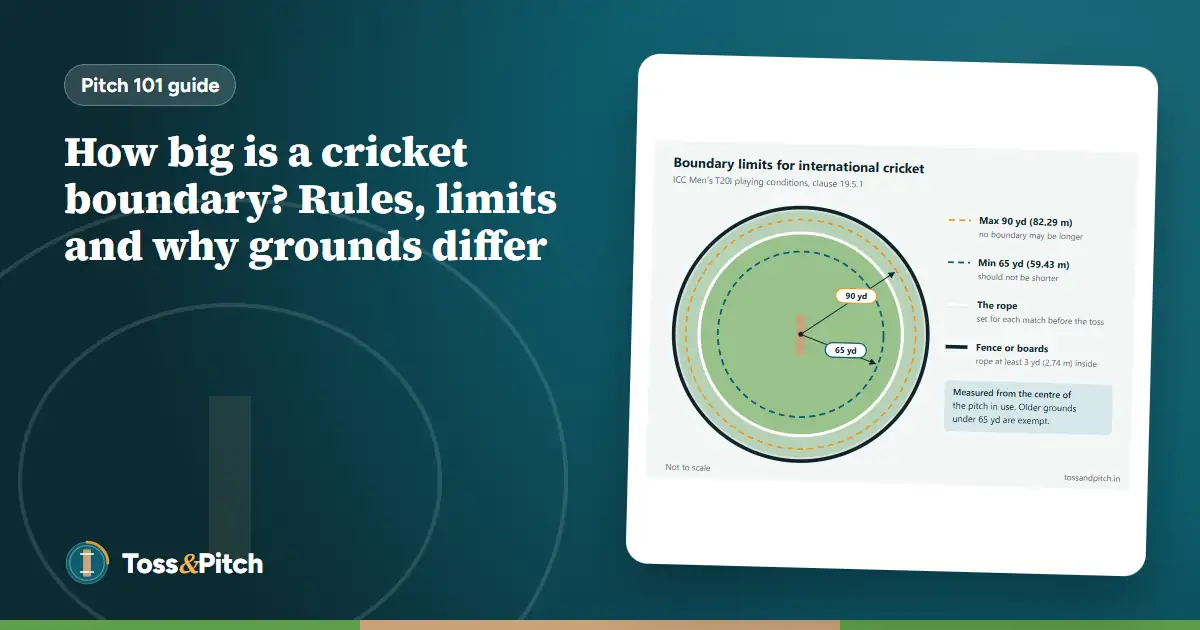
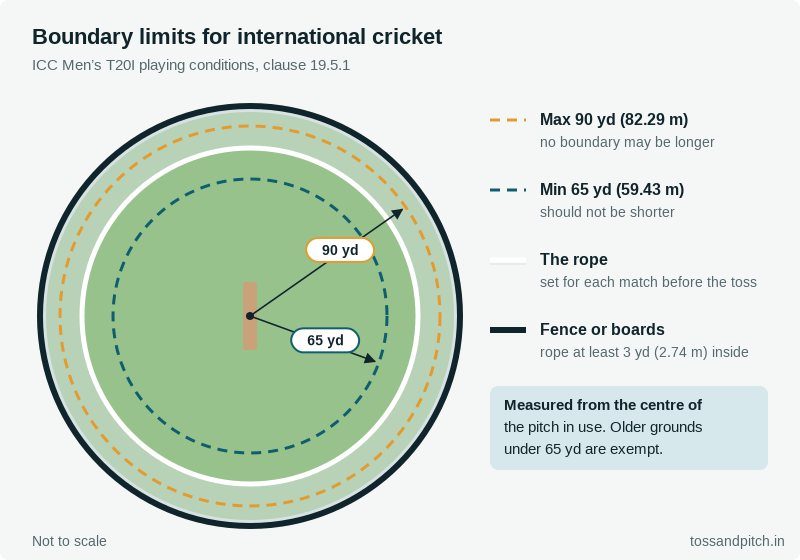
For international cricket, the ICC says no boundary may be longer than 90 yards (82.29 m), and boundaries should not be shorter than 65 yards (59.43 m). Both distances are measured from the centre of the pitch being used.
The Laws of Cricket themselves do not set any boundary size. That is why grounds around the world, and across India, differ so much.
What the Laws of Cricket say
Law 19 of the MCC Laws of Cricket deals with boundaries, but it is about process rather than size.
- Fixed before the toss. The umpires determine the boundary before the toss, and it stays fixed for the whole match.
- Sightscreens outside. No part of a sightscreen may be inside the field of play at any stage.
- Marking. Where practical, the boundary is a continuous white line or an object touching the ground, such as a rope. With a line, the edge nearest the pitch is the boundary. With a rope, it is the edge of the grounded part nearest the pitch.
- Obstacles. An object inside the field is not a boundary unless the umpires say so before the toss.
Because the Laws leave the distance open, each competition sets its own rules through playing conditions.
ICC playing conditions for internationals
The ICC’s Men’s T20I playing conditions, clause 19.5.1, add the distances:
| Rule | Measurement |
|---|---|
| Maximum boundary | 90 yards / 82.29 m from the centre of the pitch in use |
| Minimum boundary | 65 yards / 59.43 m from the centre of the pitch in use |
| Gap to fence or advertising | At least 3 yards / 2.74 m inside the perimeter |
The aim, in the ICC’s wording, is to make the playing area as large as possible at each venue. Grounds that were approved for international cricket before these rules and cannot meet the 65-yard minimum are exempt, but their boundaries must still be set to give the largest playing area possible.
On large grounds, the 90-yard maximum is applied first, then the 3-yard gap to the fence.
The IPL
IPL matches are played under BCCI playing conditions. We have not found a published IPL-specific boundary distance, so the ICC’s 65–90 yard range is the useful benchmark. Most IPL grounds also host international matches, where the ICC limits apply.
Boundary sizes at individual grounds are rarely published officially. Where we have a sourced figure, the venue page shows it; otherwise it says the size varies with the strip in use.
Why Indian grounds differ
Several things explain why one Indian ground feels small and another feels huge.
- The stadium’s footprint. A ground hemmed in by fixed stands in a city centre has less room for the rope than one built on open land.
- The shape. Very few grounds are perfect circles. Many are oval, so the straight boundaries and square boundaries can differ by several yards.
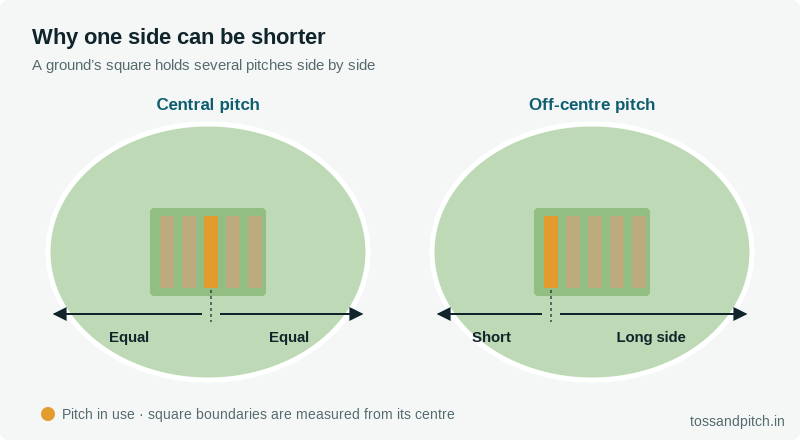
- The pitch in use. A ground’s square holds a row of pitches side by side. A central pitch gives roughly equal square boundaries. An off-centre pitch leaves one side noticeably shorter.
- The fence and advertising. The ICC rule that the rope must sit at least 3 yards inside the fence or advertising boards uses up space on smaller grounds.
The result is that the same ground can play differently from one match to the next, simply because a different pitch on the square has been chosen.
How ropes are moved between matches
Because boundary distances are measured from the centre of the pitch being used, the rope is set again for each match. Ground staff lay it out after the pitch has been chosen, keeping within the playing conditions and the required gap to the fence. The umpires then confirm the boundary before the toss.
Once the toss has taken place, the boundary cannot be changed. If a fielder or the ball knocks the rope out of place, Law 19.3 says the boundary is treated as being in its original position, and the rope is put back as soon as the ball is dead.
What it means for a match
Short side. Pitch reports often point out the shorter square boundary. Batters target it; captains set fields and plans to make them hit to the longer side.
Spinners. Bowling to the long boundary gives spinners more room to tempt batters into big shots.
Par score. A smaller playing area tends to lift scores. That is one reason a ground’s par can shift from one season to the next, even if the soil and the curator stay the same.
Six counts. Shorter boundaries usually mean more sixes. Each venue page on this site shows the average number of sixes per match in recent IPL seasons.