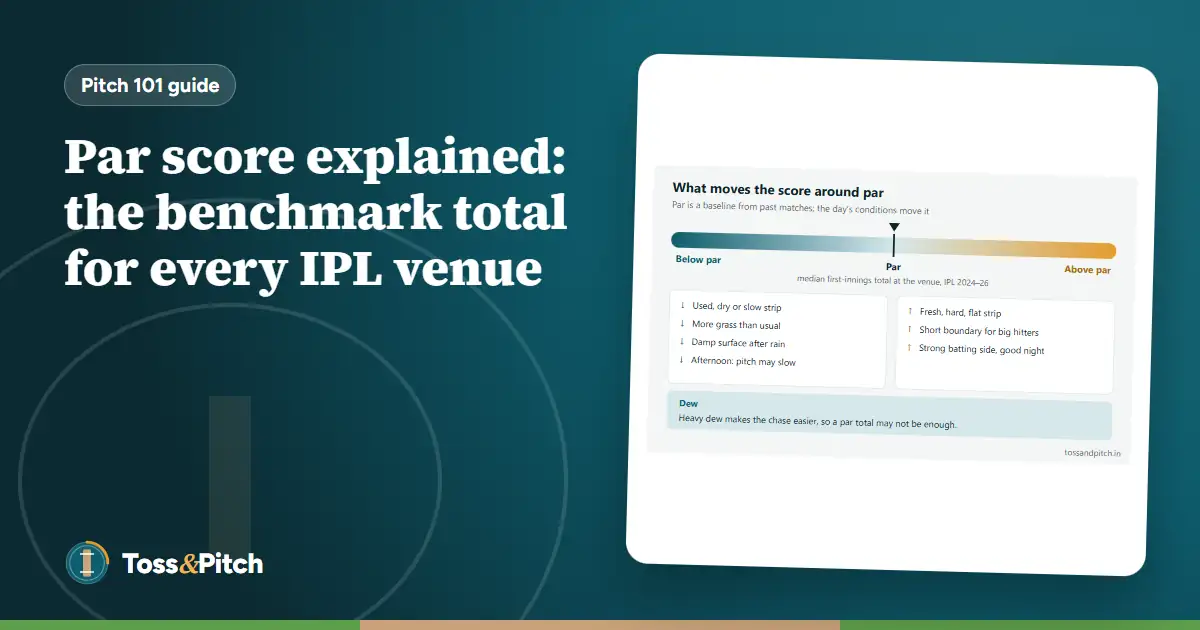
What par score means
In golf, par is the expected score for a hole. Cricket borrowed the word. A par score in T20 is the first-innings total that would be about normal at a particular ground. It answers a simple question: is 180 a good score here, or not enough?
The answer changes a lot from venue to venue. A total that is comfortably above par on a slow pitch can be well below par at a ground with a flat surface and short boundaries. That is why par is always tied to a venue, and ideally to recent seasons.
Commentators often quote a par figure from experience. This site uses a fixed, transparent method instead.
How this site calculates par
Par on every venue page is calculated the same way:
- Take every IPL match at the venue in the 2024, 2025 and 2026 seasons.
- Leave out matches with no result and matches shortened by rain, because a 12-over total is not comparable with a 20-over one.
- Take the first-innings total from each remaining match.
- Line the totals up from lowest to highest and take the middle value. That is the median, and that is par.
The data comes from Cricsheet, which publishes free ball-by-ball records of IPL matches. Our figures run through the IPL 2026 final on 31 May 2026.
We use only the last three seasons because pitches, rules and batting approaches change over time. Older totals would make par less representative of how the game is played at the ground now.
Why median, not average
An average adds every total and divides by the number of matches. It is sensitive to extremes. A single collapse or a single record total can move it by several runs when a venue has only around 20 matches in three seasons.
The median is the middle score. Half the totals are above it and half below. A single extreme innings barely moves it, so it is a steadier guide to what a normal night looks like.
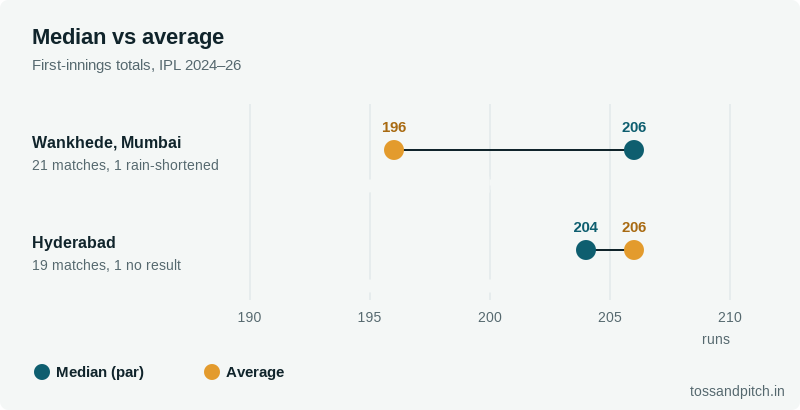
Comparing the two also tells you something. At Wankhede Stadium in Mumbai, the median first-innings total in IPL 2024–26 was 206 while the average was 196, across 21 matches with one shortened by rain. That gap means a few low totals pulled the average down; a typical first innings there was higher than the average suggests.
Where the median and average sit close together, scoring at the ground has been consistent. At Rajiv Gandhi International Stadium in Hyderabad they were 204 and 206 across 19 matches, one of them without a result.
What moves par on the day
Par is a baseline built from past matches. On match day several things can push the expected score above or below it.
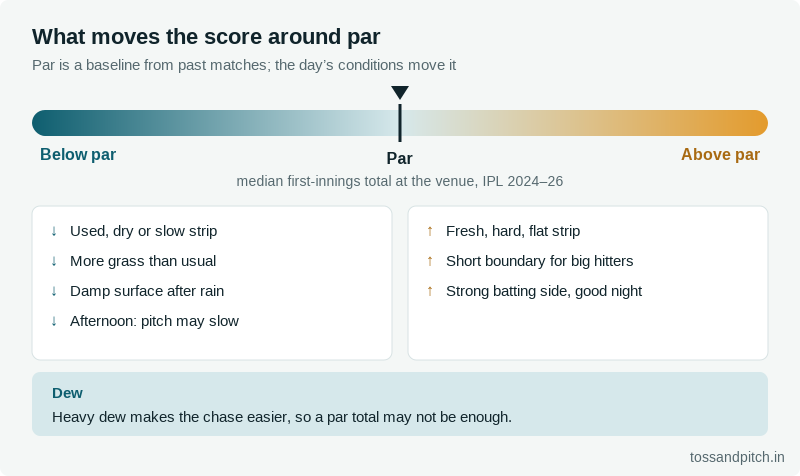
The pitch. A fresh, hard, flat strip tends to play above par. A used, dry or slow strip, or one with more grass than usual, tends to play below it.
The boundaries. The rope can be moved between matches, and the pitch in use may sit off-centre on the square. A short side for the big hitters adds runs.
Dew. Heavy dew makes the second innings easier, so a first-innings total that looks like par may not be enough. The IPL’s rule allowing one ball change after the 10th over of the second innings in evening matches softens this, but does not remove it.
Heat and day games. Afternoon matches avoid dew, and the pitch may slow as it dries in the sun.
Rain. Rain before the toss can leave a damp surface, and a shortened match resets expectations entirely.
The teams. Par describes the ground, not the line-ups. A strong batting side on a good night can go well past it.
Par and the chase
Par is a first-innings benchmark, so it should be read alongside the chase record. Each venue page also shows how often the side batting second won in IPL 2024–26.
At a ground where chasing sides win most matches, finishing on par may still leave the batting-first side behind. At Ekana Stadium in Lucknow, for example, the side batting second won 70% of decided matches in IPL 2024–26, with a par of 176.
Small samples
Some venues host only a few IPL matches. A median built from two or four games is a rough guide at best. Venue pages show the number of matches behind every figure, so you can judge how much weight to give it.