The short answer
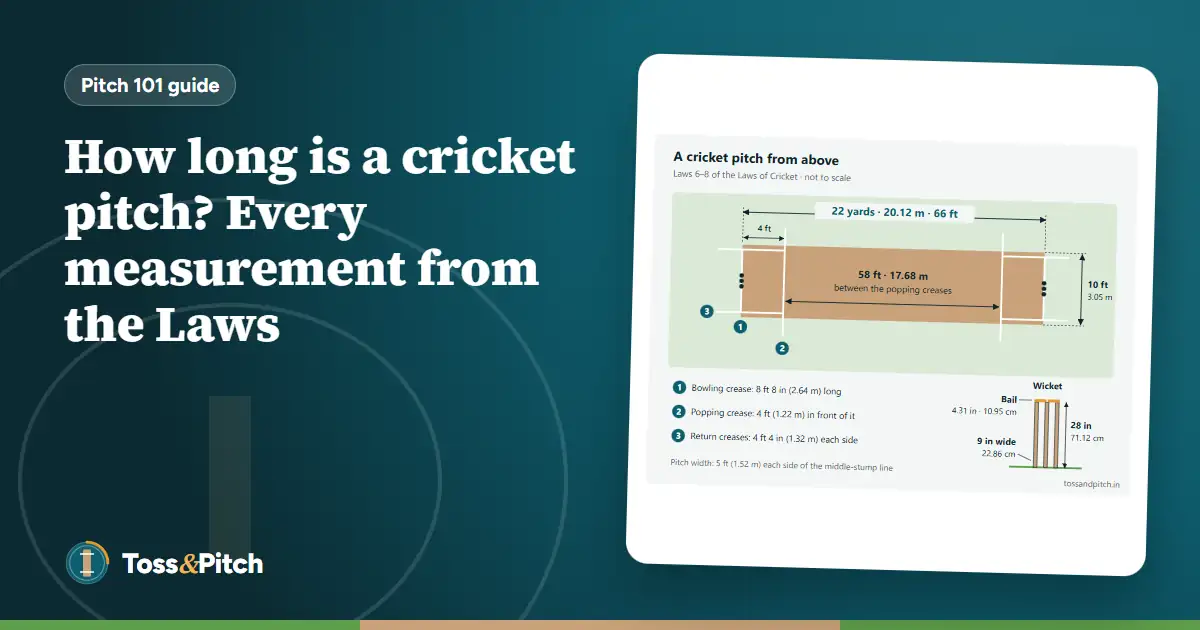
A cricket pitch is 22 yards long and 10 feet wide. In metric terms that is 20.12 m by 3.05 m. In feet, the length is 66 ft.
These figures come from Law 6.1 of the Laws of Cricket, written by the MCC, and the ICC uses the same wording in its playing conditions for Tests, ODIs and T20Is. Every IPL match is played on a pitch of exactly this size.
The length is measured between the two bowling creases, the lines on which the stumps stand. The width is 5 ft (1.52 m) on each side of an imaginary line joining the two middle stumps.
Cricket pitch dimensions at a glance
| Part | Measurement | Rule |
|---|---|---|
| Pitch length | 22 yards / 20.12 m / 66 ft | Law 6.1 |
| Pitch width | 10 ft / 3.05 m | Law 6.1 |
| Bowling crease | 8 ft 8 in / 2.64 m long | Law 7.2 |
| Popping crease | 4 ft / 1.22 m in front of the bowling crease | Law 7.3 |
| Return creases | 4 ft 4 in / 1.32 m either side of the middle-stump line | Law 7.4 |
| Width of the wicket | 9 in / 22.86 cm | Law 8.1 |
| Height of stumps | 28 in / 71.12 cm | Law 8.2 |
| Stump diameter | 1.38–1.5 in / 3.50–3.81 cm | Law 8.2 |
| Bail length | 4.31 in / 10.95 cm overall | Law 8.3 |
Because each popping crease sits 4 ft inside the bowling crease, the distance batters actually run between the two popping creases is 58 ft, or 17.68 m.
The creases, explained
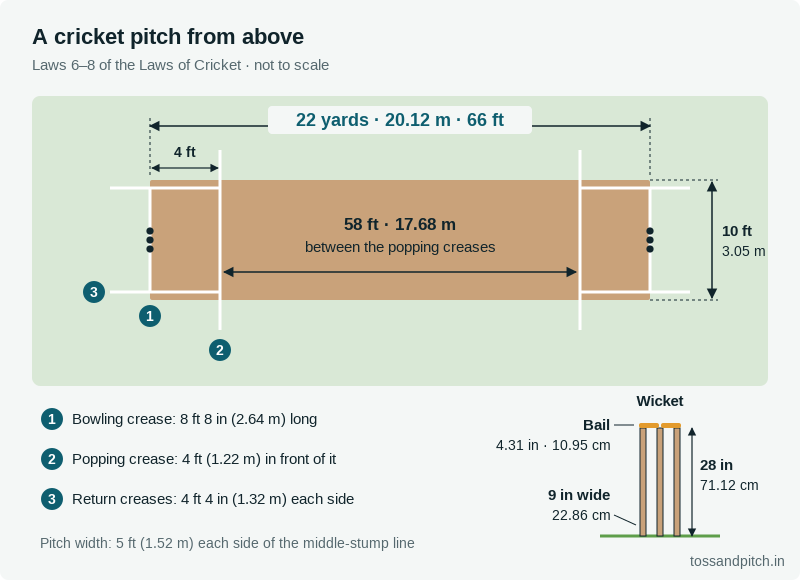
Each end of the pitch has four white lines. Their positions are fixed by Law 7.
- Bowling crease. The line through the base of the stumps. It marks the end of the pitch and is 8 ft 8 in (2.64 m) long. The back edge of the painted line is the crease itself.
- Popping crease. Drawn 4 ft (1.22 m) in front of the bowling crease and parallel to it. The batter takes guard here and is in their ground once the bat or body is grounded behind it. For a legal delivery, part of the bowler’s front foot must land behind it. The MCC Laws require it to be marked at least 6 ft (1.83 m) either side of the middle-stump line; ICC T20I conditions ask for at least 15 yards (13.71 m) each side. In both cases it counts as unlimited in length.
- Return creases. Two lines at right angles to the popping crease, 4 ft 4 in (1.32 m) either side of the middle-stump line. They are marked from the popping crease to at least 8 ft (2.44 m) behind it. The bowler’s back foot must land inside them.
The popping and bowling creases are measured to the back edge of their marking, while the return creases are measured to the inside edge.
Stumps and bails
Two sets of wickets stand in the centre of the bowling creases, facing each other 22 yards apart. Each set has three wooden stumps and two bails, and is 9 in (22.86 cm) wide.
The tops of the stumps are 28 in (71.12 cm) above the playing surface. Each stump is between 1.38 in (3.50 cm) and 1.5 in (3.81 cm) in diameter.
Each bail is 4.31 in (10.95 cm) long overall. That is made up of a 2.13 in (5.40 cm) barrel, a longer spigot of 1.38 in (3.50 cm) and a shorter spigot of 0.81 in (2.06 cm). When in place, the bails may not stick up more than 0.5 in (1.27 cm) above the stumps.
The good length area
“Good length” is not a line on the pitch. It is the stretch where a ball is hardest to play, because the batter cannot comfortably go fully forward or fully back.
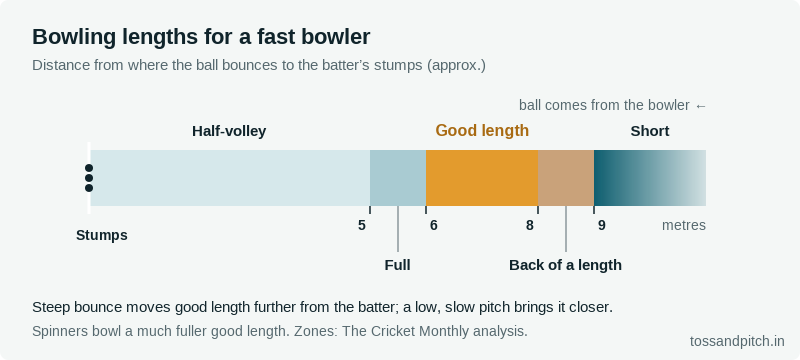
Bowling lengths are measured from the point where the ball bounces to the batter’s stumps. In analysis published by The Cricket Monthly, the zones for a fast bowler are roughly:
- under 5 m: half-volley
- 5–6 m: full
- 6–8 m: good length
- 8–9 m: back of a length
- over 9 m: short
These are guides, not rules. On a pitch with steep bounce the good length moves further from the batter; on a low, slow pitch it moves closer. Spinners bowl a much fuller good length because the ball travels slower. When a pitch report mentions cracks or rough “on a length”, it means this zone, where most deliveries land.
Pitch, ground and boundary are not the same
People often say “pitch” when they mean the whole ground. In the Laws they are different things.
- Pitch. The 22-yard strip between the bowling creases, 10 ft wide.
- Square. The prepared central area of a ground, which holds several pitches side by side. Ground staff choose which one is used for each match.
- Field of play. Everything inside the boundary. Its size is not fixed by the Laws.
- Boundary. The edge of the field of play, usually a rope. Under ICC playing conditions for international matches it must be no more than 90 yards from the centre of the pitch in use, and should be at least 65 yards.
So a “big ground” and a “long pitch” are separate ideas: every pitch is 22 yards, but boundaries differ from venue to venue and even from match to match.
Cricket pitch diagram, in words
Picture the pitch from above, starting at one end:
- The bowling crease, 8 ft 8 in long, with the three stumps in its centre.
- The two return creases, running back from the popping crease 4 ft 4 in either side of the stumps.
- The popping crease, 4 ft in front of the stumps.
- 58 ft of pitch between the two popping creases, with the good length zone about 6–8 m in front of each set of stumps.
- The same markings repeated, mirrored, at the far end.
Junior and artificial pitches
The 22-yard length applies to senior cricket on grass. Law 6 lets each country’s governing body decide pitch length for junior cricket. An artificial pitch must be at least 58 ft (17.68 m) long and 6 ft (1.83 m) wide.