
What dew is
Dew is water that condenses on the grass when the air close to the ground cools down. Every parcel of air holds some water vapour. The dew point is the temperature at which that air becomes saturated. Once the air cools to the dew point, it can no longer hold all its moisture and the excess settles as droplets.
So the key number is the gap between air temperature and dew point. When the gap is large, the air is dry and dew is unlikely. When the gap closes to a few degrees, as it often does on humid evenings, dew becomes likely.
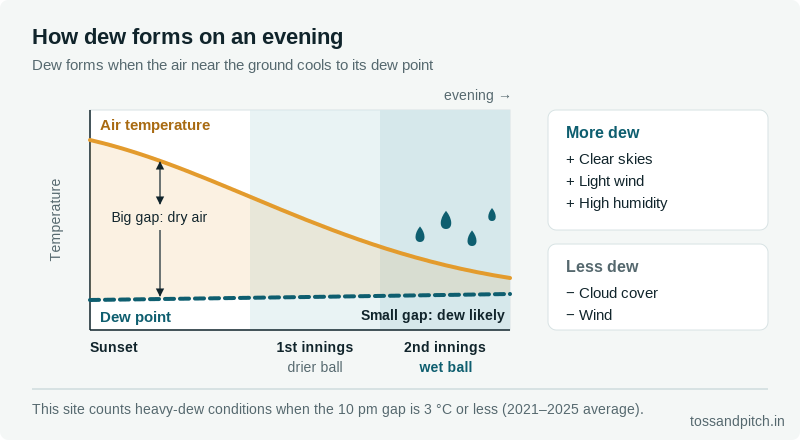
Grass can also cool faster than the air above it on a clear, still night, so dew can form even when the air temperature reading looks safe. Cloud cover and wind tend to reduce it.
Why dew helps the chasing side
In an evening IPL match the first innings starts soon after sunset, before the ground has cooled much. Dew tends to build later, so the side bowling second is the one that faces it.
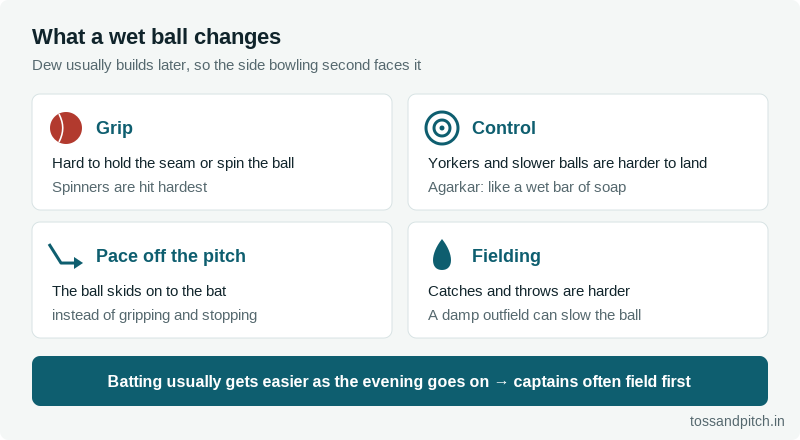
A wet ball affects the game in several ways.
- Grip. Bowlers struggle to hold the seam or put revolutions on the ball. Spinners are hit hardest.
- Control. Yorkers and slower balls are harder to land. Former India bowler Ajit Agarkar compared bowling with a wet ball to bowling with a wet bar of soap.
- Pace off the pitch. A wet ball tends to skid on to the bat instead of gripping and stopping.
- Fielding. Catches and throws are harder, and a damp outfield can slow the ball.
The result is that batting usually gets easier as the evening goes on. That is the main reason IPL captains so often choose to field first after winning a night toss.
Dew does not always arrive. On some nights it never comes, and on others it settles during the first innings too. That is why the toss decision is a judgement, not a formula.
When and where dew is heaviest in India
Dew depends on humidity, clear skies and how much the temperature drops after sunset. In broad terms:
- Coastal and eastern venues such as Kolkata, Chennai and Guwahati stay humid through the IPL months, so dew is a regular factor in March, April and May.
- Northern venues such as Delhi, Lucknow and Mullanpur are hot and dry in the IPL window. Their heaviest dew comes in winter, which matters for international matches from December to February.
- After the monsoon, in September and October, many venues across the country see frequent dew; in our data September is the peak month at most grounds.
This site’s climate table measures how often the gap between temperature and dew point at 10 pm is 3 °C or less, averaged over 2021–2025. Some examples from that data:
| Venue | Evenings with heavy-dew conditions |
|---|---|
| Eden Gardens, Kolkata | 53% in April, 67% in May |
| Chepauk, Chennai | 66% in March, 63% in April |
| Barsapara, Guwahati | 61% in April, 84% in May |
| Arun Jaitley Stadium, Delhi | 2% in April, 85% in January |
| Narendra Modi Stadium, Ahmedabad | 0% in April, 3% in May |
A low figure does not mean a dry outfield is guaranteed, because grass can cool below the air temperature. Treat these numbers as a measure of how often the air is close to saturation, and check each venue’s weather page for the full monthly table.
How teams manage dew
Wet-ball practice. Bowlers train with deliberately wetted balls. Dale Steyn has described this as mostly mental preparation: it cannot copy match conditions, but it makes a wet ball feel less unfamiliar.
Bowling plans. With a wet ball, bowlers often go for harder lengths rather than yorkers, use cross-seam deliveries and rely on pace bowlers over spinners late in a chase.
Drying the ball. Law 41.3 of the Laws of Cricket lets a fielder dry a wet ball on a piece of cloth approved by the umpires.
Ground staff. Boundary ropes are mopped, outfields are treated with chemicals and water-absorbing machines such as Super Soppers are used. These help, but dew keeps forming through the evening.
The ball change rule. From IPL 2025, the bowling captain in the second innings of an evening match may request one ball change after the 10th over. The request is made at the end of an over, whether or not dew is visible, and the umpires choose a replacement ball of similar wear. Umpires can also change a ball at any time if it is too wet, lost or damaged. Reports ahead of IPL 2026 said the rule continues.
The toss. Most simply, captains choose to bowl first when dew is expected, so that their bowlers face a drier ball.
How to read dew on match day
Check three things in the forecast for the evening: humidity, the gap between temperature and dew point, and cloud cover. High humidity, a narrow gap and clear skies point to dew. Then watch the first innings: if the outfield is already wet by the 15th over, the side batting second is likely to benefit.