What a pitch report is for
A pitch report is a short reading of conditions before a match. On television it is usually a former player standing on the strip with a key in hand. The aim is the same everywhere: to judge whether batting or bowling will be easier, how that might change during the match, and what total is worth chasing or defending.
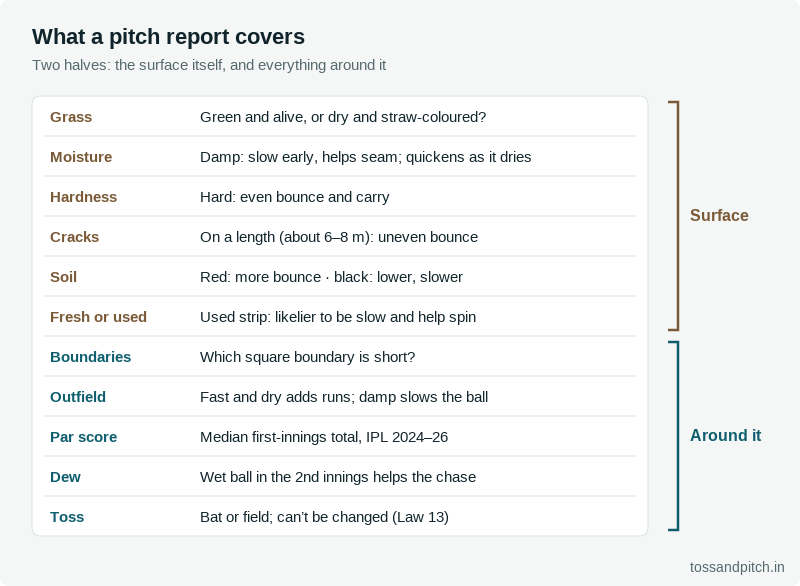
A good report has two halves. One looks at the surface itself. The other looks at everything around it: the ground, the history of the venue and the weather.
The surface: grass, moisture, hardness, cracks
Grass cover. Live green grass binds the surface and can help seam bowlers. A pitch shaved to a light brown tends to play truer for batting early and helps spinners later. Look at whether the grass is green and alive or dry and straw-coloured.
Moisture. A damp pitch can be slow early on and help seamers; as it dries it usually quickens. Reporters often press a thumb or key into the surface to judge it.
Hardness. A hard pitch gives even bounce and carry, which usually means good batting. A softer one can make the ball stop or bounce unevenly.
Cracks. Fine cracks are normal on a dry pitch. What matters is where they are. Cracks “on a length”, roughly 6–8 m from the stumps for a quick bowler, can bring uneven bounce. Cracks that widen during a match suggest the second innings will be harder.
Soil. In India reports often mention red soil or black soil. Red soil tends to give more bounce; black soil usually plays lower and slower and turns more as it wears. Both depend heavily on preparation.
Fresh or used. A fresh strip has not been played on this season. A used one has already hosted matches and is more likely to be slow and to help spinners.
The ground: boundaries and outfield
Boundary sizes. The square boundary on one side can be much shorter than the other, because the pitch in use is not always in the centre of the square. The ICC measures boundary distances from the centre of the pitch in use. Note which side is short: bowlers will try to make batters hit to the long side.
Outfield. A fast, dry outfield adds runs. A heavy or damp one, common late in an evening match with dew, slows the ball down.
History and the par score
Recent results at the same ground are the best check on what you see. They show how the square has actually played, not how it looks.
The simplest number is par: the first-innings total that would be about average at the venue. On this site par is the median first-innings total at the ground in IPL 2024–26, taken from ball-by-ball Cricsheet data. Each venue page also shows how often the side batting second has won, and average runs and wickets in the powerplay (overs 1–6), middle overs (7–15) and death overs (16–20).
Use par as a baseline, then adjust for what today’s report says: a greener or slower strip than usual pulls the expected score down; a flat, dry one pushes it up.
Weather and dew
Weather matters as much as the surface in a T20.
- Dew. In evening matches, dew can settle on the grass in the second innings. The ball gets wet and slippery, spinners struggle to grip and the ball skids on to the bat. This usually helps the chasing side.
- Humidity and cloud. Humid, overcast conditions can help swing early in the innings.
- Heat. In day games the surface dries and can quicken, then wear, as the afternoon goes on.
- Rain. Rain before the toss can leave a damp pitch and a shortened match.
From IPL 2025 the bowling captain in the second innings of an evening match can ask for one change of ball after the 10th over, which the umpires must grant. It softens the effect of dew but does not remove it.
The toss
All of the above feeds into the toss decision. If dew is expected and the pitch looks true, captains usually field first. If the pitch looks dry and likely to slow down, batting first and putting runs on the board becomes more attractive.
Under Law 13 of the Laws of Cricket, the winning captain must announce the choice immediately and cannot change it.
Putting it together
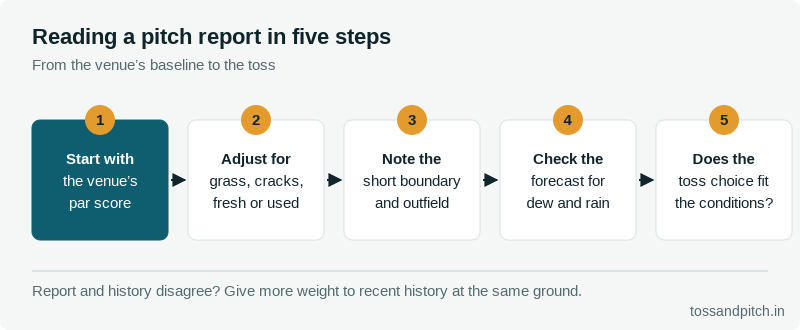
A practical way to read any pitch report:
- Start with the venue’s par score.
- Adjust it for the surface: grass, moisture, cracks, fresh or used strip.
- Note the short boundary and the outfield speed.
- Check the match-night forecast for dew and rain.
- See what the toss winner chooses, and whether that matches the conditions.
If the report and the history disagree, give more weight to recent history at the same ground, but keep the report in mind. A pitch can surprise everyone.