What the toss decides
The toss decides one thing: which captain chooses whether to bat or field first. In cricket that choice matters more than in most sports, because the two sides do not bat in the same conditions. The pitch wears, the light changes and, in evening matches, dew can settle on the ground.
The toss is also the formal start of a match. A game abandoned before the toss is generally treated as not played; one abandoned after it counts as played.
What the Laws of Cricket say
Law 13.4 of the MCC Laws of Cricket sets out the toss:
- The captains toss a coin for the choice of innings.
- It happens on the field of play, in the presence of one or both umpires.
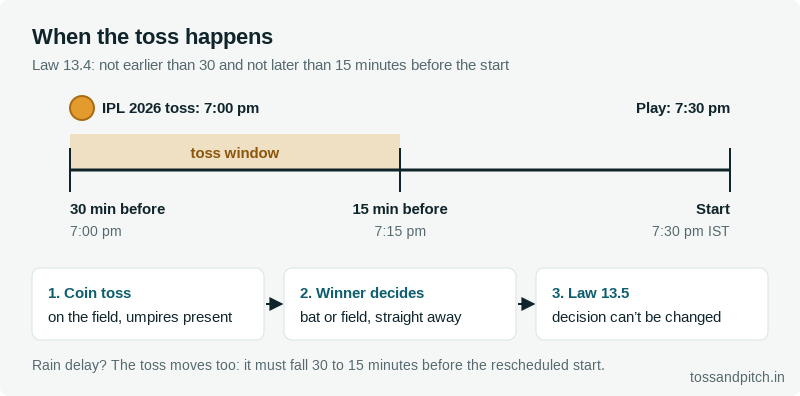
- It must take place not earlier than 30 minutes and not later than 15 minutes before the scheduled start, or any rescheduled start.
Law 13.5 covers the decision. As soon as the toss is done, the winning captain decides whether to bat or field and tells the opposing captain and the umpires. Once notified, the decision cannot be changed.
The ICC uses the same 30-to-15-minute window in its T20I playing conditions, with the toss supervised by the ICC Match Referee.
The Laws do not say which captain flips the coin and which one calls. By long custom, the home captain tosses and the visiting captain calls heads or tails. A captain can send a nominated deputy to the toss if needed.
The toss in the IPL
In IPL 2026 evening matches started at 7:30 pm IST and the toss was at 7:00 pm, at the top of the permitted window. If rain delays the start, the toss is delayed too, because it has to fall within 30 to 15 minutes of the rescheduled time.
The toss is held out in the middle with the two captains and the match officials, and the winning captain’s decision is announced on the broadcast straight away.
The Impact Player and team sheets
Since 2023 the IPL has used the Impact Player rule. It changed what happens at the toss in two ways.
- Two team sheets. Captains bring two possible playing XIs, one for batting first and one for bowling first, and confirm their XI after the toss result is known.
- One substitution. Each side names a list of substitutes and can bring one of them into the match as the Impact Player.
Before 2023, teams exchanged a single team sheet before the toss and could not adjust it. Now the toss winner and loser can both pick a side that fits the order of play. The BCCI was reviewing the rule ahead of IPL 2027; check the latest playing conditions before relying on it.
Bat or bowl: how captains choose
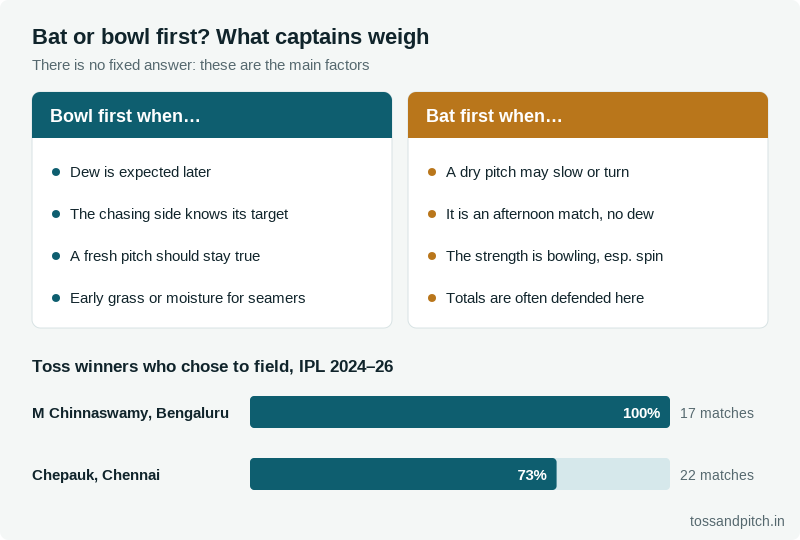
There is no fixed answer. Captains weigh several factors.
Reasons to bowl first
- Dew is expected, so the ball will be wet and harder to grip in the second innings.
- The chasing side knows exactly what it needs and can pace the innings.
- The pitch is fresh and should stay true, so batting will not get harder later.
- There is moisture or grass early, which may help seamers in the first few overs.
Reasons to bat first
- The pitch is dry and likely to slow down or turn more as it wears.
- The match is in the afternoon, when dew is not a factor.
- The team’s strength is its bowling, especially spin, and it wants to defend a total.
- The venue’s recent history shows totals being defended more often than chased.
In evening IPL matches, fielding first has become the standard choice at many grounds. At M Chinnaswamy Stadium in Bengaluru, every toss winner in IPL 2024–26 chose to field (17 matches). At Chepauk in Chennai, where the pitch often slows, 73% chose to field over 22 matches.
How much does winning the toss matter?
Less than people often think. Winning the toss gives a choice, not a result. If the conditions are balanced, the toss winner’s edge is small. It grows when conditions change sharply during the match, for example on a night with heavy dew or on a dry pitch that starts to break up.
Each venue page on this site shows how often toss winners chose to field and how often they went on to win in IPL 2024–26, so you can see whether the toss has mattered at that ground.